Binance hot wallet breach
On the evening of 29 October 2026, assets worth about $6.3 billion were taken out of Binance’s hot wallets on ten blockchains. Most of the money was gone within about 20 minutes. We examined the drain transactions, the EIP-7702 technique, the race to freeze and where the money sits today using public blockchain data.
The incident is about four times the size of the $1.5 billion Bybit attack of February 2025 and the largest crypto theft on record.
Activity map
- Total impact
- ~$6.3 billion
- Date
- 29 October 2026
- Chains affected
- 10 blockchains
- Frozen
- ~$3 billion
Overview
Exchanges pay out customer withdrawals from hot wallets kept online. These wallets sign thousands of transactions automatically every day. To the chain, a valid signature means the transaction is authorized; the chain cannot see who asked for the signature.
According to Binance’s initial statement, the entry point was a compromised DevOps engineer’s laptop; the company said it found no evidence of a private key leak. Valid signatures were produced on ten different chains, with different key types and signature schemes, within half an hour. That points to an attacker able to make Binance’s signing system sign whatever transaction they wanted.
We verified the attacker addresses and the drain transactions one by one from public blockchain records, read where the money sits today, and compared the attacker addresses with those of earlier major attacks and with sanctions lists. All addresses and transaction IDs are public blockchain data.
Timeline
- 23 June 2026A macOS device that accessed Binance internal systems with a corporate account was compromised by MacSync Stealer (Dark Radar data).
- 27 September 2026The device's log entered Dark Radar data while circulating in a Telegram log distribution channel, 32 days before the attack.
- 28 October, morningThe attacker's operations wallet receives three small withdrawals from Tornado Cash. TRM Labs
- 29 October, during the dayThe attack code is deployed, tested on two wallets and rehearsed on a third; the sweeper contract is deployed at 15:59. TRM Labs
- 29 October 20:05–20:09XRP Ledger: five transfers from five Binance accounts to a single recipient, 233.46 million XRP in total (verified on-chain).
- ~20:10Binance wallets on Solana, Optimism and Base are drained. TRM Labs
- 20:20:06Bitcoin: 18,270.2 BTC in 11 transactions in the same block (verified on-chain).
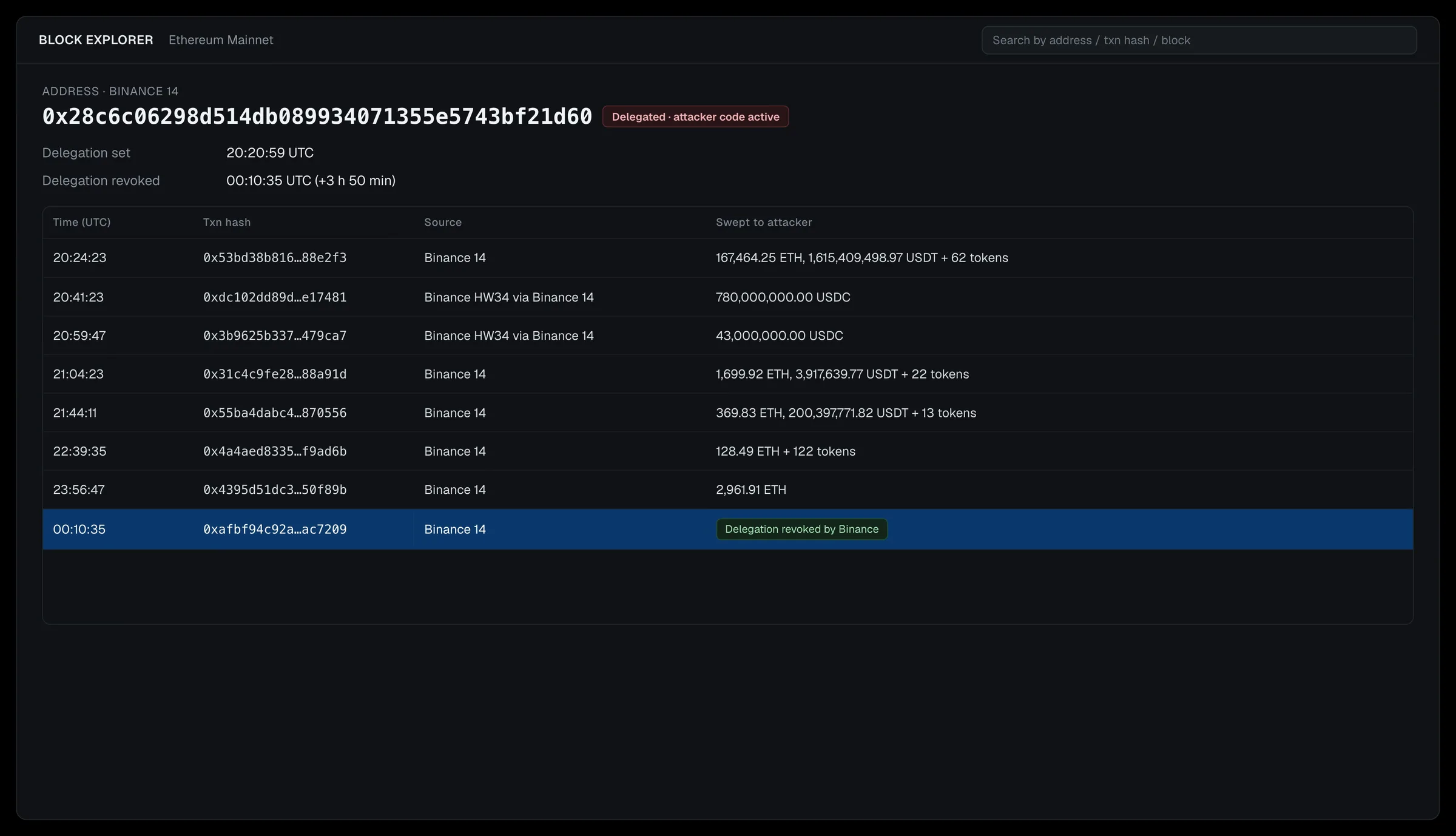
- 20:20:59Ethereum: a transaction carrying 50 EIP-7702 authorizations; one succeeds and Binance 14 is delegated to the attacker's contract.
- 20:22:45Tron: 612.7 million USDT in a single transaction (verified on-chain).
- 20:24:23Ethereum: a single sweep from Binance 14 of 167,464 ETH, 1.615 billion USDT and more than 60 tokens (~$2.5 billion).
- 20:24:47Binance 16 sends 9 separate transfers to the same recipient (including 28,005.6 ETH).
- 20:41 and 20:59780 and 43 million USDC are withdrawn from Binance's USDC smart account.
- 21:01 / 21:04Tether freezes the main recipient wallet; three minutes later Circle freezes 823 million USDC. TRM Labs
- 21:04 – 23:56New balance arriving at Binance 14 is swept five more times.
- 23:05Second wave: Polygon and, according to TRM Labs, Avalanche. Blockaid reports that the Avalanche wallets were drained within 12 minutes of the main sweep. TRM Labs
- 30 October 00:08The Arbitrum Security Council forcibly moves 8,426 ETH and 74.6 million ARB out of the attacker's Arbitrum wallet. TRM Labs
- 30 October 00:10:35Binance revokes the EIP-7702 authorization; the delegation had stayed open for 3 hours 50 minutes. Bitquery
- 30 OctoberBinance announces its initial findings: a compromised DevOps laptop and no evidence of a private key leak. Euronews
- 31 OctoberBinance announces it has replenished 90% of the losses; withdrawals are planned to reopen on 1 November. Reuters
Attack chain
- 1
Preparation
- The operations wallet (0x7c86…5ca0) received three withdrawals from Tornado Cash’s 0.1 ETH pool on 28 October at 07:39 and 08:53 and on 29 October at 08:23.
- At 02:28 on 29 October it deployed the first contract; between 13:51 and 14:24 it tried EIP-7702 delegation and sweeping on two test wallets.
- At 15:59 it deployed the actual sweeper contract (0x63e8…6fae) and ran a rehearsal on a third wallet between 16:20 and 16:30.
- 2
Access to the signing infrastructure
- According to Binance’s initial statement, an internal service was reached through a compromised DevOps engineer’s computer and unauthorized withdrawal transactions were submitted.
- Binance later said it had found other points of compromise and that the attackers used a mechanism that erased traces.
Where it breaks today: Engineer devices with access to the signing infrastructure should be monitored as closely as the most critical assets.
- 3
Persistent control with EIP-7702
- EIP-7702 lets an ordinary Ethereum wallet run a smart contract’s code through a signed authorization; the authorization stays valid until it is replaced with a new one.
- Because Binance 14 was processing withdrawals continuously, its transaction nonce kept advancing. The attacker submitted 50 pre-signed authorizations for the 50 consecutive nonces 18,914,775–18,914,824 in a single transaction.
- 49 authorizations were rejected as “invalid nonce”; only the authorization for nonce 18,914,809 was applied.
Where it breaks today: Code appearing at an address that should have none should raise an immediate alert; a batch authorization request for consecutive nonces is an indicator of compromise.
- 4
The sweep
- 3 minutes 24 seconds later the operations wallet told Binance 14 to send its own balance to the attacker; no new signature was needed.
- Because the authorization stayed open, new money arriving at the wallet was swept again at 21:04, 21:44, 22:39 and 23:56. Binance revoked the authorization at 00:10:35 on 30 October.
Where it breaks today: A revocation transaction should be prepared and tested in advance.
- 5
Other chains
- Binance wallets on Bitcoin, Tron, XRP, Solana, Arbitrum, Optimism, Base, Avalanche and Polygon sent money to the attacker with ordinary signed transfers, without delegation.
- Twenty-four seconds after the main sweep, a second Binance wallet sent nine transfers to the same recipient under its own signature: the attacker could reach the signing process of several wallets at once.
Where it breaks today: Signing and approval paths should be separated by chain and wallet tier; inventory-sized transfers to new addresses should be stopped at the signing stage.
The drain, minute by minute
Between 20:05 and 23:56 (UTC) on 29 October 2026, 40 transfers went from Binance wallets to the attacker on ten chains. The largest drains happened in the first 20 minutes; the issuers’ first freeze came at 21:01.
At 20:05 the first transfer starts on the XRP Ledger.
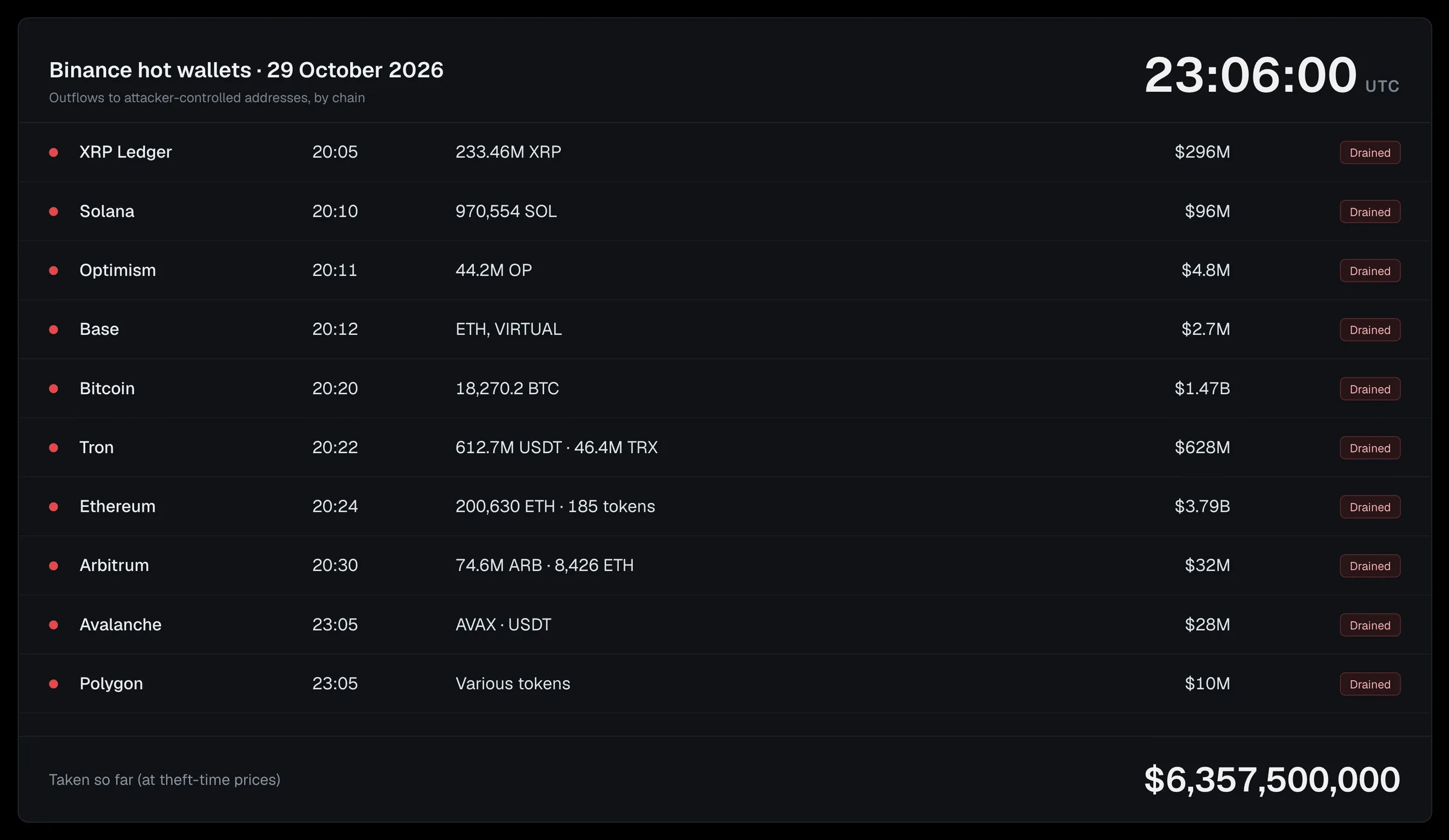
Wallet movements
Transfers from Binance wallets to the attacker in time order (UTC). We read the “Verified on-chain” rows one by one from public blockchain records (Blockscout, mempool.space, TronGrid, XRPL and Solana nodes); the other rows are totals from published analyses.
| Time | Chain | From | To | What left | Transaction | Verification | Source |
|---|---|---|---|---|---|---|---|
| 20:05:00 | XRP Ledger | rDAE53VfMv…fht6JPxr | rK21t6nGLy…25qgfzMx | 185,017,485.50 XRP | 78E31E7BB0…F50BFA6A | Verified on-chain | |
| 20:07:00 | XRP Ledger | rBtttd61FE…jFEceA1A | rK21t6nGLy…25qgfzMx | 14,693,052.50 XRP | 6DDF398B69…3C5B7E67 | Verified on-chain | |
| 20:08:20 | XRP Ledger | rfQ9EcLkU6…47Rk8Cvi | rK21t6nGLy…25qgfzMx | 13,140,680.40 XRP | 9FE8F79876…E52C6AAA | Verified on-chain | |
| 20:08:50 | XRP Ledger | rarG6FaeYh…sPn2bZKk | rK21t6nGLy…25qgfzMx | 11,955,157.60 XRP | 27C7D0D5ED…B8D385F5 | Verified on-chain | |
| 20:09:20 | XRP Ledger | rNU4eAowPu…gxcKExpK | rK21t6nGLy…25qgfzMx | 8,655,567.10 XRP | 0571C4D970…9A595DB0 | Verified on-chain | |
| ~20:10 | Solana | 5tzFkiKscX…bhUvuAi9 | AffzFDKZby…yGigBEaU | 970,554 SOL | — | Recipient balance verified on-chain; time from published analysis | TRM Labs |
| ~20:10 | Optimism | Binance 55 | 0x5227f603…fccb2f8c | 44.2 million OP | — | Published analysis | Blockaid |
| ~20:10 | Base | Binance | — | ~$2.7 million | — | Published analysis | Bitquery |
| 20:20:06 | Bitcoin | bc1qm34lsc…f0j77s3h | bc1q0mtc2f…fjhl2mnm | 7,636.80 BTC | 82c0b6f217…42df04ce | Verified on-chain | |
| 20:20:06 | Bitcoin | bc1qm34lsc…f0j77s3h | bc1q0mtc2f…fjhl2mnm | 4,696.60 BTC | 3b1d3ded49…1c432b32 | Verified on-chain | |
| 20:20:06 | Bitcoin | bc1qm34lsc…f0j77s3h | bc1q0mtc2f…fjhl2mnm | 2,946.90 BTC | 574bc276eb…5c02190f | Verified on-chain | |
| 20:20:06 | Bitcoin | bc1qm34lsc…f0j77s3h | bc1q0mtc2f…fjhl2mnm | 1,409.50 BTC | 5de2320e6c…7c47f0ba | Verified on-chain | |
| 20:20:06 | Bitcoin | bc1qm34lsc…f0j77s3h | bc1q0mtc2f…fjhl2mnm | 773.10 BTC | d3084140c0…d413410d | Verified on-chain | |
| 20:20:06 | Bitcoin | bc1qm34lsc…f0j77s3h | bc1q0mtc2f…fjhl2mnm | 369.60 BTC | d9bf6caa09…fc69f651 | Verified on-chain | |
| 20:20:06 | Bitcoin | bc1qm34lsc…f0j77s3h | bc1q0mtc2f…fjhl2mnm | 194.30 BTC | 6736fc2914…7e77ca84 | Verified on-chain | |
| 20:20:06 | Bitcoin | bc1qm34lsc…f0j77s3h | bc1q0mtc2f…fjhl2mnm | 112.10 BTC | 48ba4e60cc…7ad1e6a1 | Verified on-chain | |
| 20:20:06 | Bitcoin | bc1qm34lsc…f0j77s3h | bc1q0mtc2f…fjhl2mnm | 67.20 BTC | 6722aa3e38…f9cccec0 | Verified on-chain | |
| 20:20:06 | Bitcoin | bc1qm34lsc…f0j77s3h | bc1q0mtc2f…fjhl2mnm | 44.20 BTC | 8b02cfb945…605a5cbf | Verified on-chain | |
| 20:20:06 | Bitcoin | bc1qm34lsc…f0j77s3h | bc1q0mtc2f…fjhl2mnm | 19.90 BTC | f9dcbbc63e…52110313 | Verified on-chain | |
| ~20:22 | Tron | TDqSquXBgU…89dkhSCf | TG5iBMQPrD…J1wvzsGi | 46.4 million TRX | — | Published analysis | TRM Labs |
| 20:22:45 | Tron | TDqSquXBgU…89dkhSCf | TG5iBMQPrD…J1wvzsGi | 612,729,468 USDT | 4203af9ca1…5958253e | Verified on-chain | |
| 20:24:23 | Ethereum | Binance 14 (0x28c6c062…3bf21d60) | 0x5227f603…fccb2f8c | 167,464.25 ETH, 1,615,409,498.97 USDT, 62,597,239.68 RLUSD, 82.54 WBTC and 60 other tokens | 0x53bd38b8…0e88e2f3 | Verified on-chain | |
| 20:24:47 | Ethereum | Binance 16 (0xdfd5293d…1343963d) | 0x5227f603…fccb2f8c | 583,592,986,820.10 PEPE | 0x9f21e145…a532ecf2 | Verified on-chain | |
| 20:24:47 | Ethereum | Binance 16 (0xdfd5293d…1343963d) | 0x5227f603…fccb2f8c | 304,598.20 LINK | 0xa87c6a03…bef55653 | Verified on-chain | |
| 20:24:47 | Ethereum | Binance 16 (0xdfd5293d…1343963d) | 0x5227f603…fccb2f8c | 18,819,171.40 ENA | 0xe07f61ff…8ddf2b52 | Verified on-chain | |
| 20:24:47 | Ethereum | Binance 16 (0xdfd5293d…1343963d) | 0x5227f603…fccb2f8c | 1,199.30 XAUT | 0xcb5bb7c0…d72accfe | Verified on-chain | |
| 20:24:47 | Ethereum | Binance 16 (0xdfd5293d…1343963d) | 0x5227f603…fccb2f8c | 819,997.10 UNI | 0xb1f99ca5…d800f295 | Verified on-chain | |
| 20:24:47 | Ethereum | Binance 16 (0xdfd5293d…1343963d) | 0x5227f603…fccb2f8c | 84.50 WBTC | 0x2c45d787…0e6f260b | Verified on-chain | |
| 20:24:47 | Ethereum | Binance 16 (0xdfd5293d…1343963d) | 0x5227f603…fccb2f8c | 25,943,825.80 RLUSD | 0x2e100162…9e5ffeb3 | Verified on-chain | |
| 20:24:47 | Ethereum | Binance 16 (0xdfd5293d…1343963d) | 0x5227f603…fccb2f8c | 55,739,800.50 USDT | 0xd4e08d3e…8fd6c49c | Verified on-chain | |
| 20:24:47 | Ethereum | Binance 16 (0xdfd5293d…1343963d) | 0x5227f603…fccb2f8c | 28,005.60 ETH | 0x51f263fa…d62fd39f | Verified on-chain | |
| ~20:30 | Arbitrum | Binance (4 wallets) | 0x5227f603…fccb2f8c | 74.6 million ARB and 8,426 ETH | — | Published analysis | Blockaid |
| ~20:36 / 23:05 | Avalanche | Binance (4 wallets) | 0x5227f603…fccb2f8c | 1.81 million AVAX and 8.41 million USDT | — | Time varies by source (~20:36 Blockaid, 23:05 TRM Labs) | Blockaid |
| 20:41:23 | Ethereum | Binance Hot Wallet 34 (USDC smart account) (0xee7ae85f…d63b4055) | 0x5227f603…fccb2f8c | 780,000,000.00 USDC | 0xdc102dd8…b5e17481 | Verified on-chain | |
| 20:59:47 | Ethereum | Binance Hot Wallet 34 (USDC smart account) (0xee7ae85f…d63b4055) | 0x5227f603…fccb2f8c | 43,000,000.00 USDC | 0x3b9625b3…60479ca7 | Verified on-chain | |
| 21:04:23 | Ethereum | Binance 14 (0x28c6c062…3bf21d60) | 0x5227f603…fccb2f8c | 1,699.92 ETH, 3,917,639.77 USDT, 0.10 WBTC and 21 other tokens | 0x31c4c9fe…d888a91d | Verified on-chain | |
| 21:44:11 | Ethereum | Binance 14 (0x28c6c062…3bf21d60) | 0x5227f603…fccb2f8c | 369.83 ETH, 200,397,771.82 USDT and 13 other tokens | 0x55ba4dab…40870556 | Verified on-chain | |
| 22:39:35 | Ethereum | Binance 14 (0x28c6c062…3bf21d60) | 0xa97bf783…3fae8d10 | 128.49 ETH and 122 other tokens | 0x4a4aed83…44f9ad6b | Verified on-chain | |
| 23:05 | Polygon | Binance | — | ~$10 million | — | Published analysis | TRM Labs |
| 23:56:47 | Ethereum | Binance 14 (0x28c6c062…3bf21d60) | 0xa97bf783…3fae8d10 | 2,961.91 ETH | 0x4395d51d…a650f89b | Verified on-chain |
The 18,270 BTC publicly described as sent “in one go” appears on-chain as 11 separate transactions in the same block; the largest is 7,636.8 BTC.
Following the money
Part of the assets in the attacker’s hands were stablecoins their issuers could freeze (USDT, USDC, RLUSD, USD1). In the first hours the attacker raced to convert freezable assets into ones that cannot be frozen.
Of the 2.49 billion USDT stolen on Ethereum and Tron, 1.76 billion (71%) was frozen by Tether. The remaining 729 million USDT was converted to ETH and TRX before the freeze reached it (Bitquery).
Wallets where USDT was locked (million USDT)
- 0x5227…2f8cEthereum1,175
- TG5iBM…wvzsGiTron313
- 0xaa24…54a0Ethereum175
- TCzBTk…7Y62Tron66
- 0xb171…c8c3Ethereum30
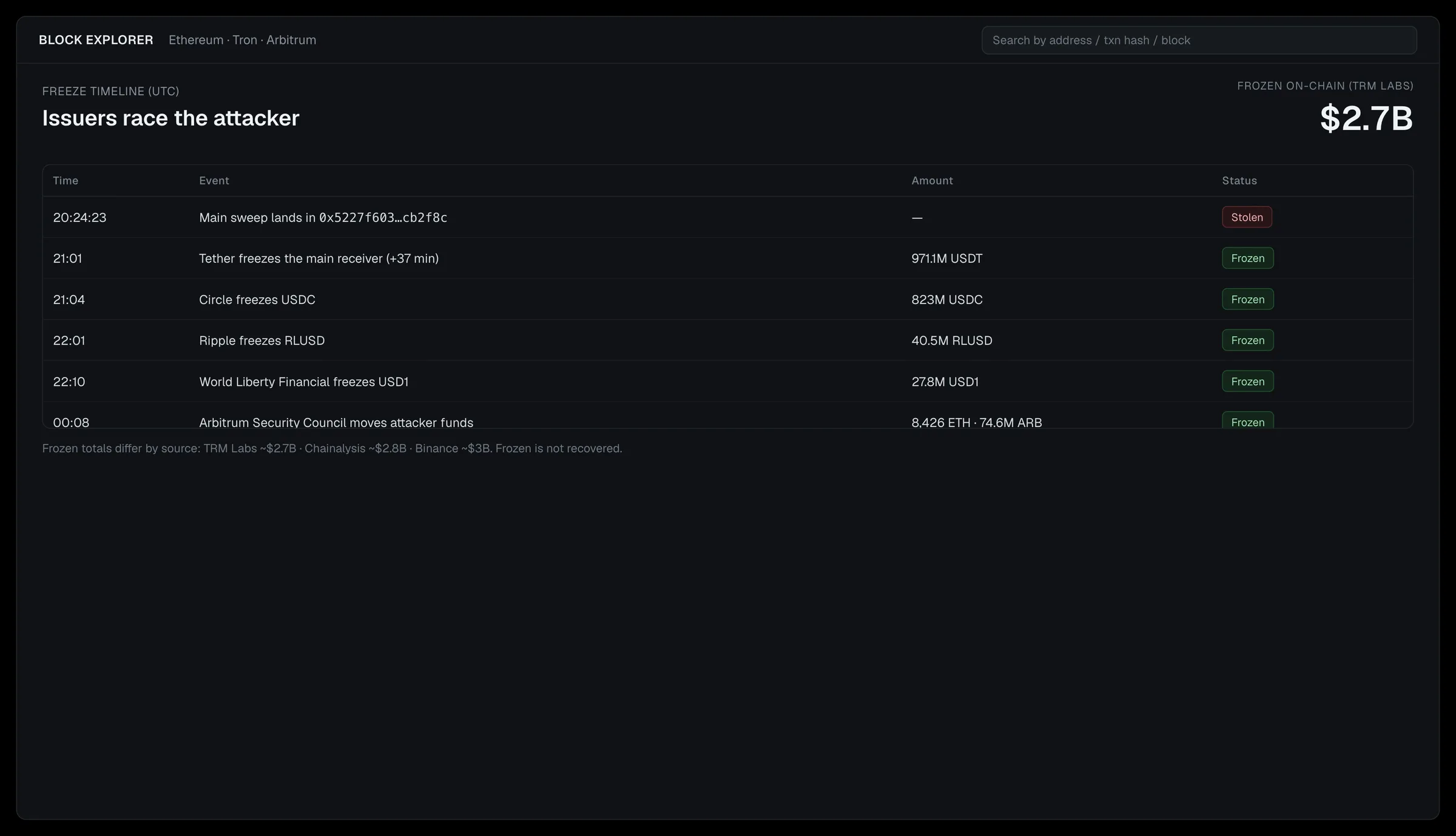
| Time (UTC) | Who | What was frozen / seized | Source |
|---|---|---|---|
| 21:01 | Tether | 971.1 million USDT in the main recipient wallet (37 minutes after the main sweep); ~1.77 billion USDT in total | TRM Labs |
| 21:04 | Circle | 823 million USDC; later 1.56 million USDC | TRM Labs |
| 22:01 | Ripple | 40.5 million RLUSD | TRM Labs |
| 22:10 | World Liberty Financial | 27.8 million USD1 | TRM Labs |
| 30 October 00:08 | Arbitrum Security Council | 8,426 ETH and 74.6 million ARB, moved without the attacker's signature | TRM Labs |
Selling at a loss: about 325 million USDT was sold through intent-based contracts for ~122,300 ETH; the price implied by the sale was more than 10% above the market.
Borrowing: one attacker wallet deposited 60 million USDT into Aave V3 and borrowed ~19,760 ETH; Aave then froze 175 V3 reserves on 16 networks and 117 V4 reserves on 4 networks.
Freezes that came too late: 6 of the 11 wallets Tether froze were already empty at the moment of the freeze.
On the Bitcoin side, 18,270.2 BTC was split into 1,000 BTC pieces, with the final consolidation at 20:48.
What the attacker still holds
Balances read from the chain on 2 November 2026. None of the seven large ETH stores has an outgoing transaction.
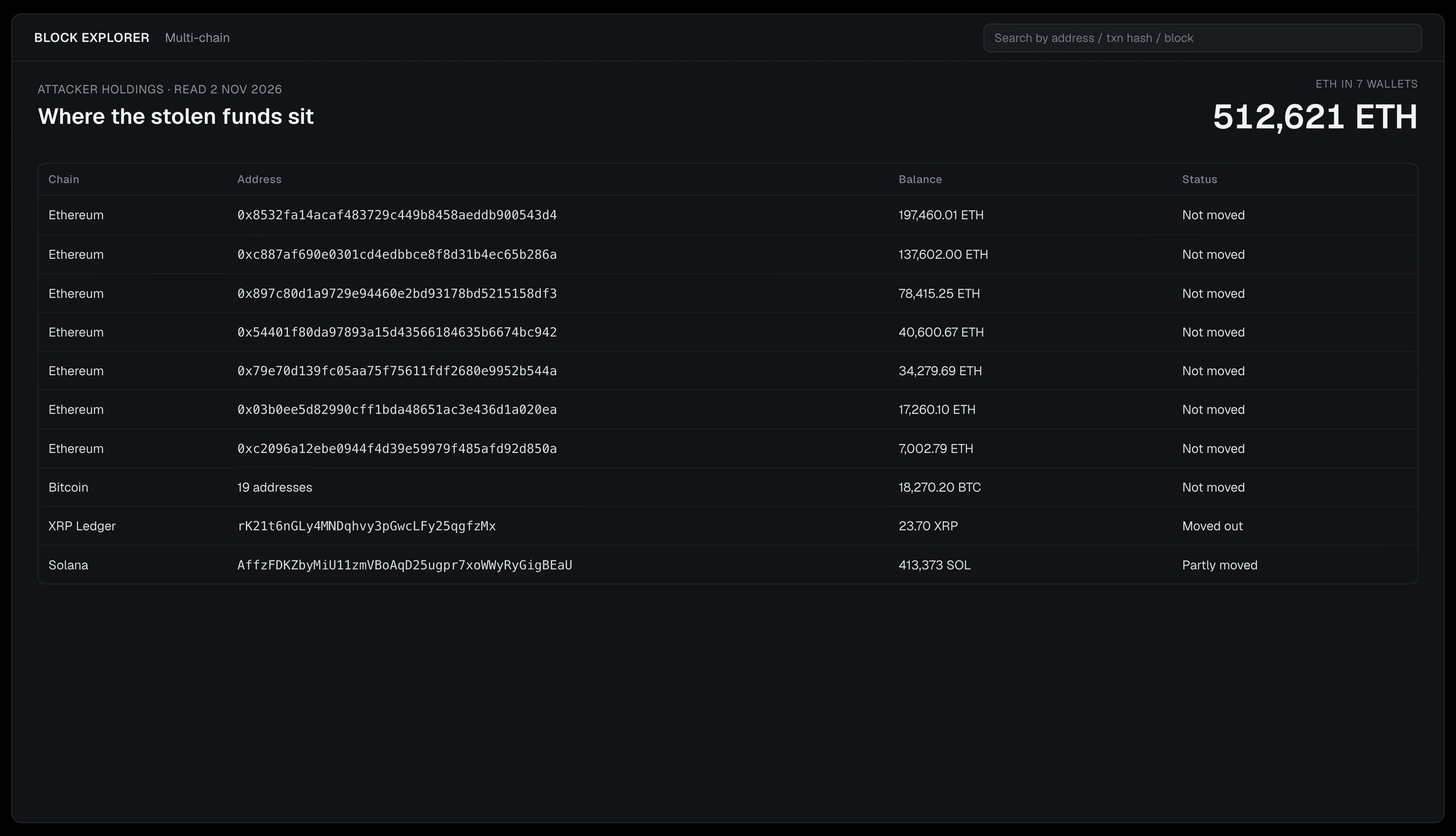
| Chain | Address | Balance | Status |
|---|---|---|---|
| Ethereum | 0x8532fa14acaf483729c449b8458aeddb900543d4 | 197,460.01 ETH | No outgoing transactions |
| Ethereum | 0xc887af690e0301cd4edbbce8f8d31b4ec65b286a | 137,602.00 ETH | No outgoing transactions |
| Ethereum | 0x897c80d1a9729e94460e2bd93178bd5215158df3 | 78,415.25 ETH | No outgoing transactions |
| Ethereum | 0x54401f80da97893a15d43566184635b6674bc942 | 40,600.67 ETH | No outgoing transactions |
| Ethereum | 0x79e70d139fc05aa75f75611fdf2680e9952b544a | 34,279.69 ETH | No outgoing transactions |
| Ethereum | 0x03b0ee5d82990cff1bda48651ac3e436d1a020ea | 17,260.10 ETH | No outgoing transactions |
| Ethereum | 0xc2096a12ebe0944f4d39e59979f485afd92d850a | 7,002.79 ETH | No outgoing transactions |
| Bitcoin | 19 addresses (in the IOC table below) | 18,270.20 BTC | Unspent since the 20:48 consolidation |
| XRP Ledger | rK21t6nGLy4MNDqhvy3pGwcLFy25qgfzMx | 23.70 XRP | Moved out |
| Solana | AffzFDKZbyMiU11zmVBoAqD25ugpr7xoWWyRyGigBEaU | 413,373 SOL | Partly moved |
The 512,621 ETH in the seven stores is more than twice the 200,630 ETH stolen directly from Binance; the difference is ETH bought with stablecoins sold before they were frozen and with other tokens. TRM Labs expects bridges, swap services and over-the-counter brokers to be used in the next stage.
Dark Radar analysis
We pulled the full transaction history of 78 Ethereum, 8 Tron and 20 Bitcoin addresses belonging to the attacker, and compared these addresses and all their counterparties with the 51 addresses the FBI published for the Bybit attack, the addresses of the September 2026 Bitget attack, and the 123 Ethereum, 532 Bitcoin and 266 Tron addresses on the OFAC sanctions list.
There is no directly shared address. None of these lists’ addresses appear among the 915 Ethereum and 856 Tron counterparties of the attacker wallets either. The addresses touched by both the Binance and Bitget attackers do not show a direct link:
| Shared address | What it is |
|---|---|
| 0xf70da97812cb96acdf810712aa562db8dfa3dbef | Payout address of the Relay bridge (“Relay: Solver”). Both attackers used the Relay bridge. |
| 0x77b2043768d28e9c9ab44e1abfc95944bce57931 | ETH pool of the Stargate bridge. |
| USDT and USDC contracts, zero address | Infrastructure everyone uses. |
| 0x051f2a88aa610d2ab998fe951fec088cedee2000, 0x7c0b22d3642f335ab0f08c5fd0a38ff6262d03d7 | Personal addresses that begged both attackers for money via on-chain messages. |
Chainalysis reports that funds stolen from Binance mixed on-chain with funds from the Bitget attack. We could not independently confirm this link with public data; the connection may lie in labeled databases or deeper than the two hops we examined.
Leaked employee access
Alongside the chain data we also searched our own infostealer data. Dark Radar data holds 171 stolen account records for the corporate email domains of seven large crypto exchanges. Part of these records are not customer logins but internal systems: at five exchanges, there are corporate-account logins to identity providers, internal code repositories, internal monitoring dashboards, admin panels and cloud single sign-on portals.
On the Binance side, two compromised devices that accessed internal systems with corporate accounts stand out:
Log folder
545 saved logins; 30 of them binance.com accounts
Direct login to 13 Binance systems; 10 of them internal (code repository, monitoring dashboard user management, data platform, identity provider)
Device A · macOS 15.5
Employee device that accessed Binance internal systems with a corporate account
- Infostealer
- MacSync Stealer (high confidence)
- Infection
- 23 June 2026
- Entered Dark Radar data
- 27 September 2026
- Before the attack
- 128 days infected, 32 days in a criminal channel
- Access with a corporate account
- 13 systems; 10 of them internal development and infrastructure
Device identity · values hidden
- IP
- Hidden
- Username
- Hidden
- Password
- HiddenmacOS login password captured
- System
- macOS 15.5 (24F74)
- Computer name
- Hidden
- Serial number
- Hidden
- Hardware UUID
- HiddenHWID
- Log date
- 2026-06-23 11:30:13
Device A’s log was circulating in a Telegram log distribution channel 32 days before the attack. Logs in these channels are sold or distributed in bulk; the access data inside may have reached any buyer.
On Device A, four corporate passwords are also used on personal sites; no known corporate security software is visible on the device. Its access covers almost the entire big data platform (workflow orchestration, event stream management, notebooks) and permission to create users on a monitoring dashboard.
Device B is the closest candidate to the DevOps profile Binance described; however, its credentials date from about a year before the incident.
None of the 35 Binance logs contains a record for a wallet, signing, withdrawal, custody or key management system. None of the attack’s known wallet addresses appears in the logs.
There is no evidence that these devices are linked to the attack; we do not know whether either is the compromised DevOps laptop Binance disclosed. MacSync is a cybercrime tool and has not been attributed to TraderTraitor. The finding shows that access data leaked from engineer devices can circulate in the open for months, even at a major exchange.
A possible path (not proven): an employee’s device is compromised, its access data circulates in criminal channels or is sold, internal systems are reached, and from there the attacker moves on to the signing infrastructure. This analysis found no evidence that this path was used in the 29 October attack. The records that could answer this question conclusively are Binance’s own access logs.
The full technical details of the findings in this section were shared with the Binance security team and the FBI before publication. Internal system names, addresses, log IDs and credentials have not been published.
From laptop to withdrawal: the control chain
An attack that starts with a compromised employee computer and ends with billions of dollars in withdrawals has to get past many security controls along the way. Binance’s internal controls are not public; we say a control fell short only at the stages whose outcome is visible on-chain or in Binance’s statement, and for the other stages we describe the control that could have stopped that step. The findings in the first three stages belong to the two devices in Dark Radar data; it has not been proven that these devices were used in the 29 October attack.
- 1The device is compromisedInsufficient on the examined devices
Dark Radar data
What we knowDevice A was compromised by MacSync Stealer; this family usually infects by getting the user to run a fake Terminal command. The first infostealer on Device B arrived with a pirated software install. Device A's list of 282 applications contains no known corporate endpoint protection, device management or VPN client; it is most likely a personal device.
Control that could stop this stepAccess to internal systems only from company-managed devices with endpoint protection; awareness of pirated software and unknown commands.
- 2Credentials are collectedInsufficient on the examined devices
Dark Radar data
What we knowCorporate passwords were saved in the browser; session cookies, Google session tokens and, on Device A, the macOS login password were stolen. 4 corporate passwords were also used on personal sites.
Control that could stop this stepNo corporate passwords stored in the browser; a password manager; phishing-resistant multi-factor authentication with hardware security keys (FIDO2); short-lived, device-bound sessions.
- 3The log circulates in criminal channelsUnknown
whether the passwords and sessions were changed afterwards cannot be seen from outside.
What we knowDevice A's log was in a Telegram log channel 32 days before the attack. Device B's credentials had been stolen about a year before the incident.
Control that could stop this stepContinuous monitoring of infostealer logs for the corporate domain; when a log appears, resetting passwords, revoking sessions and tokens, and taking the device in for investigation.
- 4Internal systems are accessedUnknownWhat we know
There is no public evidence for this stage.
Control that could stop this stepZero-trust access that checks device posture at every sign-in; step-up verification for sessions from unusual locations and devices.
- 5Production and an internal service are reachedFell shortEuronews
Binance statement. Which control was bypassed has not been disclosed.
What we knowAccording to Binance, an internal service was reached through the compromised DevOps computer. Binance also said it found other points of compromise and that the attackers used a mechanism that erased traces.
Control that could stop this stepJust-in-time, time-limited and approved access to production; a two-person rule on services that can withdraw; signed builds and deployments; immutable logs kept separately where an attacker cannot erase them.
- What we know
The same actor obtained valid signatures for wallets on ten chains within half an hour. Twenty-four seconds after the sweep on Binance 14, Binance 16 sent nine transfers under its own signature.
Control that could stop this stepSeparating signing and approval paths by chain and wallet; no single internal service able to request signatures for several chains; rejecting unexpected EIP-7702 authorizations in the signing policy.
- What we know
18,270 BTC left the Bitcoin wallet in 11 transactions in the same block, 612.7 million USDT left Tron in a single transaction, and ~$2.5 billion left Ethereum in a single sweep. Most of the assets were gone in about 20 minutes.
Control that could stop this stepAmount limits per transaction and per time window; holding large transfers to new addresses with no history before signing; a destination address allowlist.
- 8Hot wallet balanceFell short
visible on-chain
What we know~$6.3 billion could be taken out of online hot wallets in a single evening.
Control that could stop this stepKeeping only the balance needed for daily withdrawals in the hot wallet; holding the rest in cold storage and capping the balance automatically.
- What we know
The EIP-7702 authorization on Binance 14 stayed open for 3 hours 50 minutes; during that time new balance arriving at the wallet was swept four more times.
Control that could stop this stepAn immediate alert when code appears on a corporate wallet that should have none; a revocation transaction prepared and tested in advance.
- 10Response and recoveryPartly workedTRM Labs
assets that could not be frozen were converted to ETH; 6 of the 11 wallets Tether froze were already empty at that moment.
What we knowTether froze 37 minutes after the main sweep and Circle three minutes later; the Arbitrum Security Council moved funds; ~$2.7–3 billion was frozen in total. Binance said it replenished 90% of the losses within two days.
Control that could stop this stepEmergency contact set up in advance with stablecoin issuers, bridges and exchanges; a reserve fund that covers user assets.
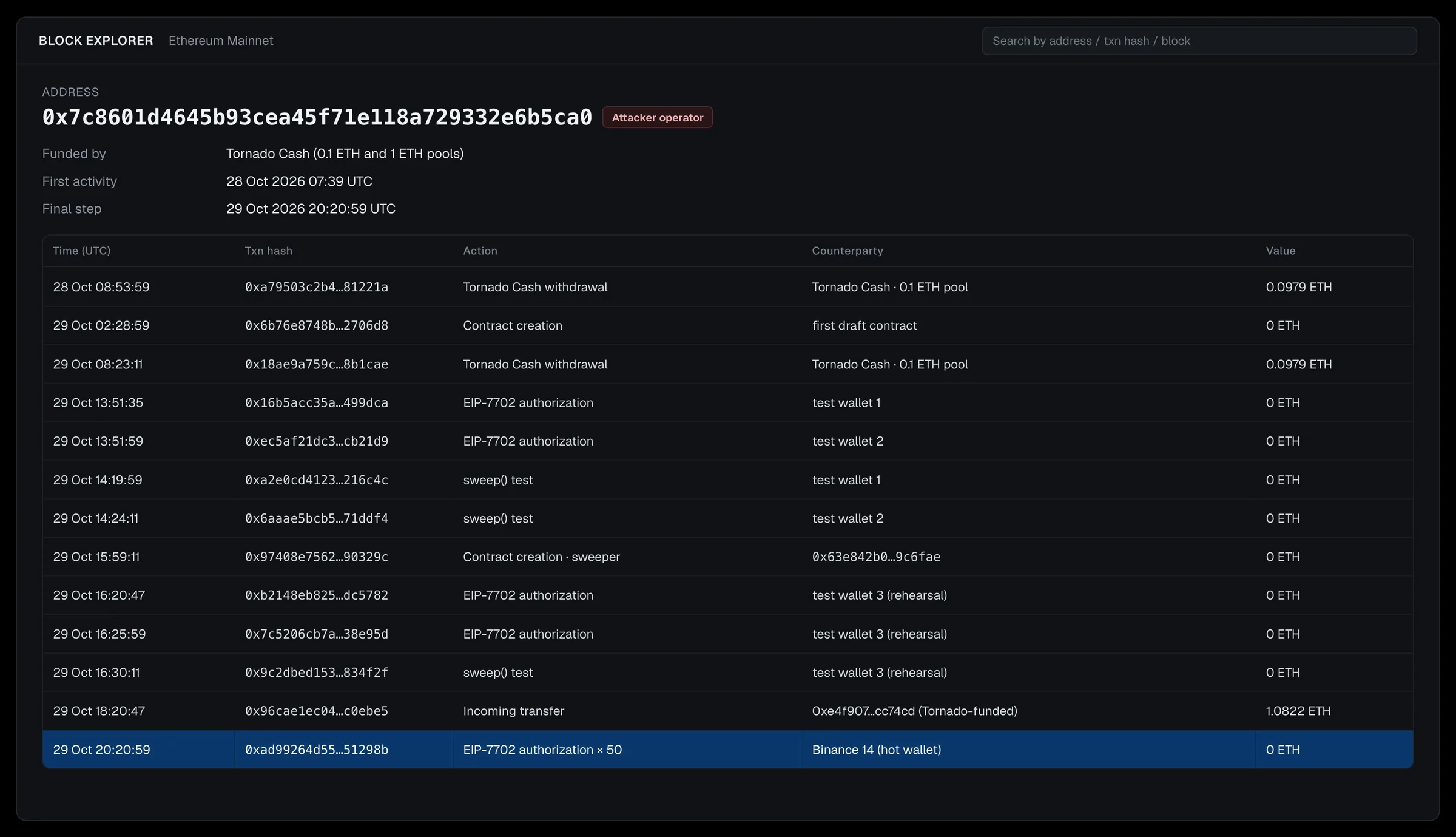
Signs visible before the attack began: the preparation was visible on-chain hours earlier. A wallet funded through Tornado Cash deployed EIP-7702 contracts during 29 October, ran tests on two wallets and deployed the sweeper contract at 15:59; the attack began at 20:20. On-chain threat monitoring that watches for wallets funded from a mixer that quickly deploy delegation contracts could have flagged this preparation before the attack. The two devices in Dark Radar data were visible 32 and about 370 days before the incident.
There was no single failure in this incident; successive layers were bypassed in turn. A breach that started at the endpoint and identity layer could have been stopped by the amount and velocity limits of the signing and withdrawal layer. The largest loss came from policy controls at the signing stage and the hot wallet balance not being proportionate to the attacker’s access.
Who did it
TRM Labs attributes the attack “with high confidence” to North Korea’s TraderTraitor group. Its basis: an operations wallet funded with small withdrawals from Tornado Cash, preparation that began well before the attack, and signatures obtained in advance and used in one go. The same pattern was seen in the Bybit (February 2025) and KelpDAO (April 2026) attacks; the FBI had attributed the Bybit attack to the same group.
On 31 October the FBI attributed the attack to North Korea’s TraderTraitor group and published addresses linked to it. Chain data does not reveal personal identity; no one has been identified as an individual in this analysis.
Impact
The loss stayed within Binance’s hot wallets; no transaction was seen directly on customer wallets. On 31 October Binance said it had replenished 90% of the losses and withdrawals reopened on 1 November.
The incident also spread beyond the exchange: Aave froze hundreds of reserves on 20 networks after the attacker’s collateralized borrowing; the Arbitrum Security Council forcibly moved the assets in the attacker’s Arbitrum wallet.
By the numbers
| Measure | Value | Source |
|---|---|---|
| Total impact | ~$6.3 billion (Binance) · $6.36 billion (TRM Labs) · ~$6.4 billion (Chainalysis) | TRM Labs |
| Frozen | ~$3 billion (Binance) · ~$2.8 billion (Chainalysis) · ~$2.7 billion (TRM Labs) | TRM Labs |
| Main sweep | ~$2.5 billion, one transaction | |
| Time the EIP-7702 authorization stayed open | 3 hours 50 minutes | Bitquery |
| Still held by the attacker | 512,621 ETH · 18,270.2 BTC · 23.7 XRP · 413,373 SOL |
Indicators (IOC)
Public blockchain addresses and transactions associated with the attacker. Wallets belonging to Binance are marked “victim”.
| Chain | Address / transaction | Role |
|---|---|---|
| Ethereum | 0x7c8601d4645b93cea45f71e118a729332e6b5ca0 | Attacker's operations (caller) wallet |
| Ethereum | 0xe4f9070e1316de2988fc6f869fead8fb99cc74cd | Wallet funded through Tornado Cash |
| Ethereum | 0x63e842b054bd624a465454d533c33f573e9c6fae | Sweeper contract run on Binance 14 |
| Ethereum | 0x5227f603c1ee34ce3c06efe6477003bdfccb2f8c | Main recipient (frozen stablecoins sit here) |
| Ethereum | 0xa97bf7836f8a08f9ed91d41453d371493fae8d10 | Second recipient |
| Ethereum | 0x8532fa14acaf483729c449b8458aeddb900543d4 | ETH store (197,460.01 ETH) |
| Ethereum | 0xc887af690e0301cd4edbbce8f8d31b4ec65b286a | ETH store (137,602.00 ETH) |
| Ethereum | 0x897c80d1a9729e94460e2bd93178bd5215158df3 | ETH store (78,415.25 ETH) |
| Ethereum | 0x54401f80da97893a15d43566184635b6674bc942 | ETH store (40,600.67 ETH) |
| Ethereum | 0x79e70d139fc05aa75f75611fdf2680e9952b544a | ETH store (34,279.69 ETH) |
| Ethereum | 0x03b0ee5d82990cff1bda48651ac3e436d1a020ea | ETH store (17,260.10 ETH) |
| Ethereum | 0xc2096a12ebe0944f4d39e59979f485afd92d850a | ETH store (7,002.79 ETH) |
| Bitcoin | bc1q0mtc2f5agpkvlq6hhahmfr3hlr55kyfjhl2mnm | First BTC recipient |
| Bitcoin | bc1qxrxujwxfnvz040jw76d26zhjdg5jura7hs968s | BTC fragment 1 (1,000.0 BTC) |
| Bitcoin | bc1qepc70u3u476vgvg3hfcwjgu4mecxe2uchs4lag | BTC fragment 2 (1,000.0 BTC) |
| Bitcoin | bc1qdfhmlrdvg4tm87zjl0vyf0xflp5ql50q3g88gw | BTC fragment 3 (1,000.0 BTC) |
| Bitcoin | bc1qnq6jj9jmlf3945m3l8s0kxnqehrsga300k8t3s | BTC fragment 4 (1,000.0 BTC) |
| Bitcoin | bc1q42flhayrzy3zh8lkyevw8qcjduurt9a35wlsyx | BTC fragment 5 (1,000.0 BTC) |
| Bitcoin | bc1qz8hdwv8gmml0u96dsvnzsagz6krjyzxmgxupdp | BTC fragment 6 (1,000.0 BTC) |
| Bitcoin | bc1q0ts8gaf9ht0rr4u02hr56f8thndqsc4kmkmfv3 | BTC fragment 7 (1,000.0 BTC) |
| Bitcoin | bc1q2wvz0kcsn4hqmajwtey30ud27fl25w8pveznn6 | BTC fragment 8 (1,000.0 BTC) |
| Bitcoin | bc1qm2j6v3247khlwzxl7p9vqnfkghcllyhv9wjaat | BTC fragment 9 (1,000.0 BTC) |
| Bitcoin | bc1qalwnl7dtaa73fsq5tyn0ghfy3fgfpqkt69tca8 | BTC fragment 10 (1,000.0 BTC) |
| Bitcoin | bc1qjwdw6vrzq4vf6hckutvx4ucj86awwv99mxnz7w | BTC fragment 11 (1,000.0 BTC) |
| Bitcoin | bc1qs3aej5tmcdz0vctz8y9rjcxtxg8v5385577s56 | BTC fragment 12 (1,000.0 BTC) |
| Bitcoin | bc1q63qrfrpsg5hh0zzn3kp2xx9vljl7dq7tatsjxp | BTC fragment 13 (1,000.0 BTC) |
| Bitcoin | bc1qs6xnmhar38z44g2za93pv8ygdcwurrh8l87w3v | BTC fragment 14 (1,000.0 BTC) |
| Bitcoin | bc1qg3nrzpuvq2pxqx74tcrywr09dc208ze96n3t53 | BTC fragment 15 (1,000.0 BTC) |
| Bitcoin | bc1qf5cyvv9w50tx9xx9s3xwsne0z87wvjj9l8a35u | BTC fragment 16 (1,000.0 BTC) |
| Bitcoin | bc1qm8v88m5fy6kuq9myva2eemwycxqd3e0zcrs2l8 | BTC fragment 17 (1,000.0 BTC) |
| Bitcoin | bc1qrg025e2pgx0rwya2kpgtj30972p64jt0hn6zyt | BTC fragment 18 (832.5 BTC) |
| Bitcoin | bc1qxg0l4p6xc50zuv9cl5f0l0wmaxjpg8wcy7s9ra | BTC fragment 19 (437.7 BTC) |
| Tron | TG5iBMQPrDzJJAUM8GMVBf1hRaJ1wvzsGi | First Tron recipient (312.7 million USDT frozen) |
| Tron | TKkH2vH6kyi2QKcMbqym53WMuvdd1xvw6K | TRX store |
| Tron | TRBdWqHnDVSZCVGfgHdKFLQPirQcA2PRki | TRX distribution wallet |
| XRP Ledger | rK21t6nGLy4MNDqhvy3pGwcLFy25qgfzMx | XRP recipient |
| Solana | AffzFDKZbyMiU11zmVBoAqD25ugpr7xoWWyRyGigBEaU | SOL recipient |
| Ethereum (transaction) | 0xad99264d5532ae0dd04b2004eebda05f25657e70dacb764f7ac8d4ccd051298b | Transaction carrying 50 EIP-7702 authorizations |
| Ethereum (transaction) | 0x53bd38b816c23e74134786c29a8c18d792777998a3b9326047b583100e88e2f3 | Main sweep of ~$2.5 billion |
| Ethereum (victim) | 0x28c6c06298d514db089934071355e5743bf21d60 | Binance 14 |
| Ethereum (victim) | 0xdfd5293d8e347dfe59e90efd55b2956a1343963d | Binance 16 |
| Ethereum (victim) | 0xee7ae85f2fe2239e27d9c1e23fffe168d63b4055 | Binance Hot Wallet 34 |
| Bitcoin (victim) | bc1qm34lsc65zpw79lxes69zkqmk6ee3ewf0j77s3h | Binance Bitcoin hot wallet |
| Tron (victim) | TDqSquXBgUCLYvYC4XZgrprLK589dkhSCf | Binance Tron hot wallet |
| Solana (victim) | 5tzFkiKscXHK5ZXCGbXZxdw7gTjjD1mBwuoFbhUvuAi9 | Binance Solana hot wallet |
Detection and prevention
According to Binance’s statement, the attack started with an employee’s computer. Compromised access data often enters underground markets before the incident; engineer devices with access to the signing infrastructure should be monitored as closely as the most critical assets.
Compliance teams should add the attacker addresses and the new wallets fed from them (Bitcoin fragments, ETH stores, addresses fed through THORChain and Relay) to deposit screening; the funds are expected to reach exchanges, swap services and OTC desks in the coming days.
Method and limitations
- The starting address list is the addresses published by Bitquery, Blockaid and TRM Labs; addresses and transactions were read one by one through public APIs (Blockscout, mempool.space, TronGrid, XRPL, Solana RPC).
- Amounts on Optimism, Base, Arbitrum, Avalanche and Polygon were taken from published analyses; they were not read individually on-chain.
- The outgoing transaction history of the two largest recipient wallets was pulled incompletely because of an API page limit; incoming transfers are complete.
- Balances were read on 2 November 2026; they may change as the funds move. Dollar values are the sources’ prices at the time of the theft.
- Dark Radar infostealer data was examined in aggregate; no person, log ID, internal domain, IP address or credential has been published. Internal system detection is based on domain and private network address patterns.
- Binance has not yet published its root cause analysis; information about the entry point is based on the company’s initial statement.
Sources
- 1North Korea Steals USD 6.36 Billion From Binance in the Largest Hack in History · TRM Labs, 29–30 October 2026
- 2The $6.4 Billion Binance Hack: Tracing the North Korea Link · Chainalysis, 30 October 2026
- 3Binance hack: on-chain investigation · Bitquery, 29–31 October 2026
- 4Binance $6.3B Hack incident report · Blockaid, 29 October 2026
- 5Binance hit by major hack as billions in crypto funds are frozen · Euronews, 30 October 2026
- 6Binance Hack 2026: How $6.3B Was Stolen · ChangeNOW
- 7Binance hot wallet exploit: Aave’s response · LlamaRisk / Aave Governance
- 8Binance says 90% of stolen assets replenished · Reuters, 31 October 2026
- 9FBI says North Korea was behind the $6.3 billion Binance crypto hack · NBC News, 31 October 2026
- 10PSA250226: North Korea Responsible for $1.5 Billion Bybit Hack · FBI IC3
- 11Bitget hack: how $387M left, and where it is now · Bitquery, September 2026
- 12Digital currency addresses on the OFAC sanctions list · 0xB10C (GitHub)
- 13EIP-7702: Set Code for EOAs · Ethereum Improvement Proposals
- Category
- Case analysis
- Type
- Crypto exchange breach
- First seen
- 29 October 2026
- Binance
- crypto theft
- EIP-7702
- TraderTraitor
- on-chain analysis
- TLP:CLEAR
More cases
Threat Intelligence
Track ransomware groups, victim posts and indicators of compromise, and see the records that match your own assets.